
Tourner un plan de drone qui tiendra au montage
Many corporate films open with an aerial shot that doesn’t tie in with anything else. You decide the fate of this shot during location scouting, not whilst in the air: its path, duration, direction and how it ties in with the ground shots. Our filming and editing guidelines, and the on-site constraints that go with them.
Many corporate films open with an aerial shot. The location seen from above, in a slow pan, four seconds before the first shot on the ground. If we’ve got a wide shot that works, we put it at the start, and the rough cut ends there.
An aerial shot filmed without any intention of editing doesn’t tie in with anything else. It remains a postcard placed at the front of the film, and the viewer sees it before we do.
We fly our drones ourselves, with the relevant certification. None of the points below can be resolved by the equipment alone.
One movement, one piece of information
What each journey reveals, regardless of where it was filmed.
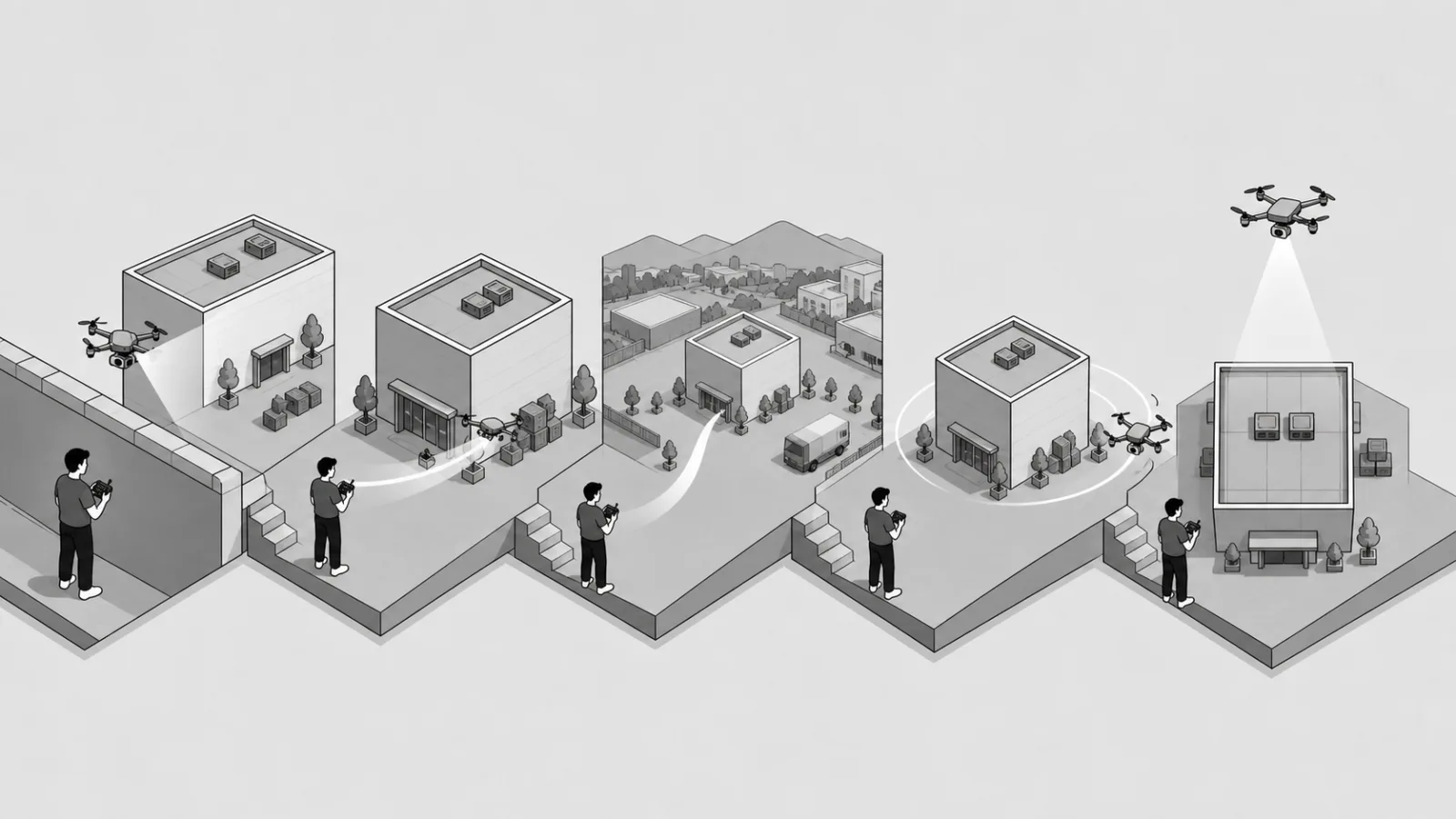
Five movements cover the bulk of what we film, each with its own specific purpose.
The reveal: the subject appears from behind a ridge, a roof or a row of trees. It reveals information rather than giving it away straight away, and serves as an opening.
The push: we enter the scene; something begins. It requires a clear point of arrival, otherwise the shot feels unfocused.
The pull-back: we move away from the subject; the setting opens up. A closing movement. If used at the start, you’re effectively ending the film before you’ve even begun it.
The orbit: you circle a stationary subject to isolate it. It works well on a building or a machine, but becomes gratuitous when used on a group of people.
The 90° vertical俯拍: it eliminates depth and scale. Good for visual transitions, but poor for establishing a location.
Five career paths, five roles
Revelation, thrust, retreat, orbit and vertical movement around a single location.
Turn for the assembly table
Duration, entry and exit points, direction of movement.
In a corporate film, an aerial shot should rarely last more than four to six seconds. Any longer, and the editing loses its rhythm. Each flight path must therefore be able to be cut cleanly.
In practice: three seconds of steady movement before the key moment, and three seconds afterwards. A drone that accelerates or decelerates within the shot cannot be cut cleanly.
Each flight path is filmed twice, once slowly and once quickly. You only choose the speed during editing, once the ground shots have been finalised.
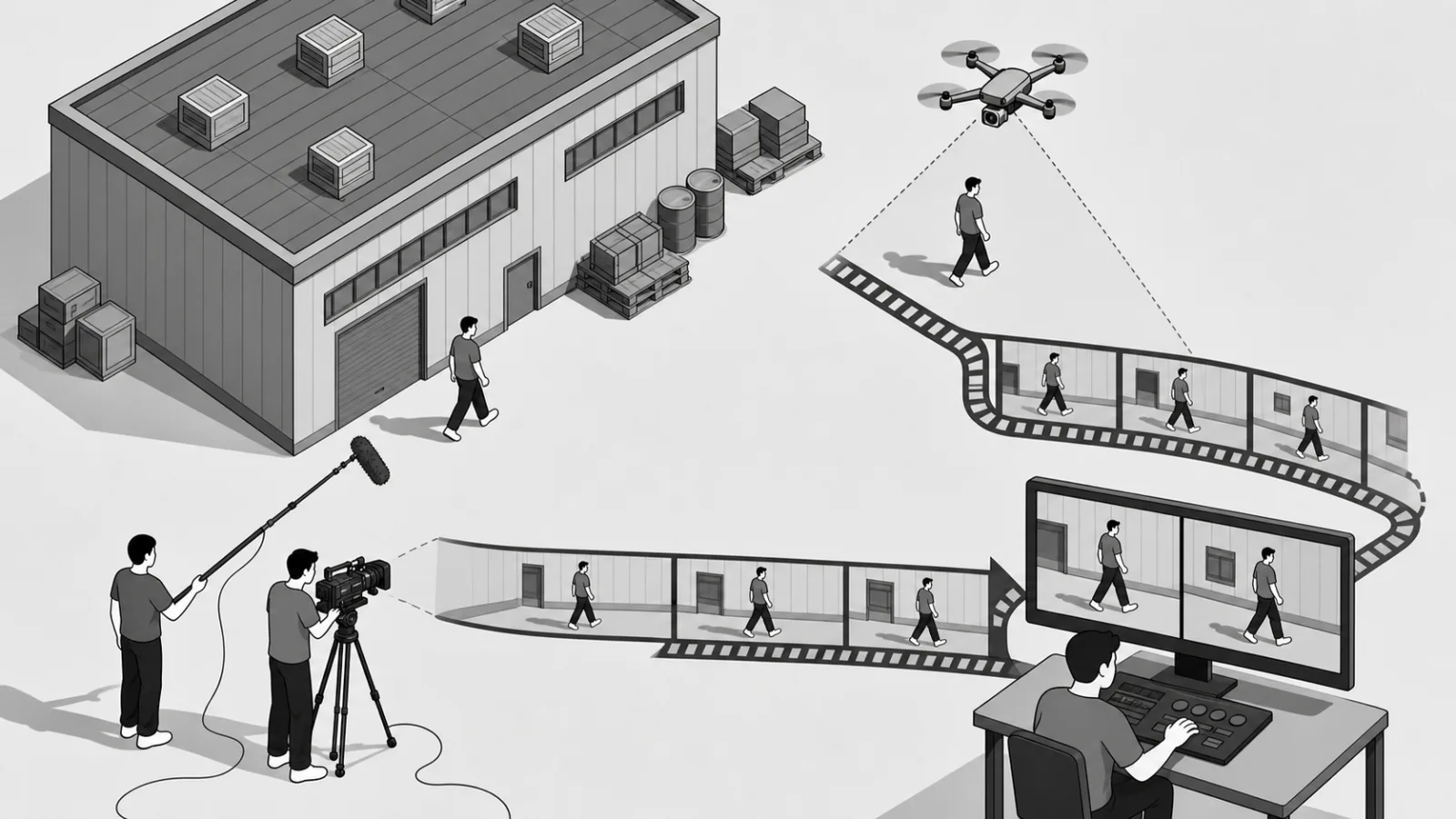
The direction of movement should follow on from the previous shot. If the subject is walking to the right, the drone should move to the right. An aerial shot that contradicts the direction of the previous shot breaks the continuity, even if the image is beautiful.
From theft to the timeline
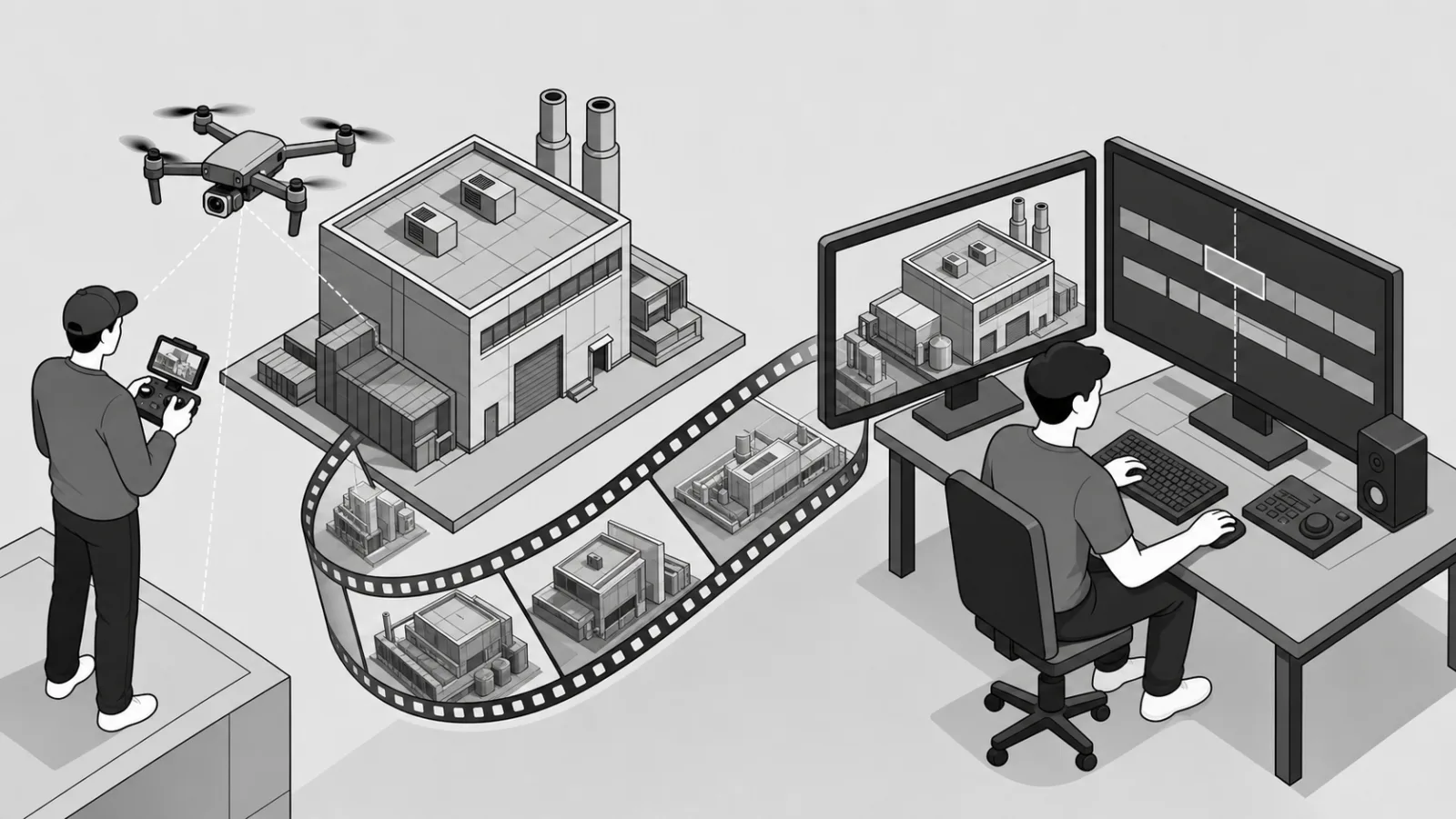
The shot is filmed with its margins before being selected and cropped during editing.
Connect with the ground
Lighting, focus and sound: three areas where it differs from the rest of the shoot.
A drone does not provide any usable audio. Dialogue and narration remain on the ground. The aerial footage focuses on music, atmosphere or voice-over.
Lighting is the first thing to break continuity. A forty-minute gap between ground shots and aerial footage means the colour grading no longer matches, regardless of the calibration. We schedule the aerial shots within the same time slot as the ground filming, not at the end of the day when there’s time to spare.
The drone’s wide-angle lens distorts and flattens the image. For a close-up shot, a long focal length blends in better with the rest of the footage. This is the main purpose of on-board telephoto lenses: to maintain the same optical language as the main camera.
It’s a question of balance: one aerial shot for every five to six shots at most. Any more than that, and you’re simply showing off the equipment.
Have the aerial and earth connected
Same direction, same lighting, same scale of subject.
Speed, scale, foreground
A high-altitude flight seems slow: the close-up shot corrects this.
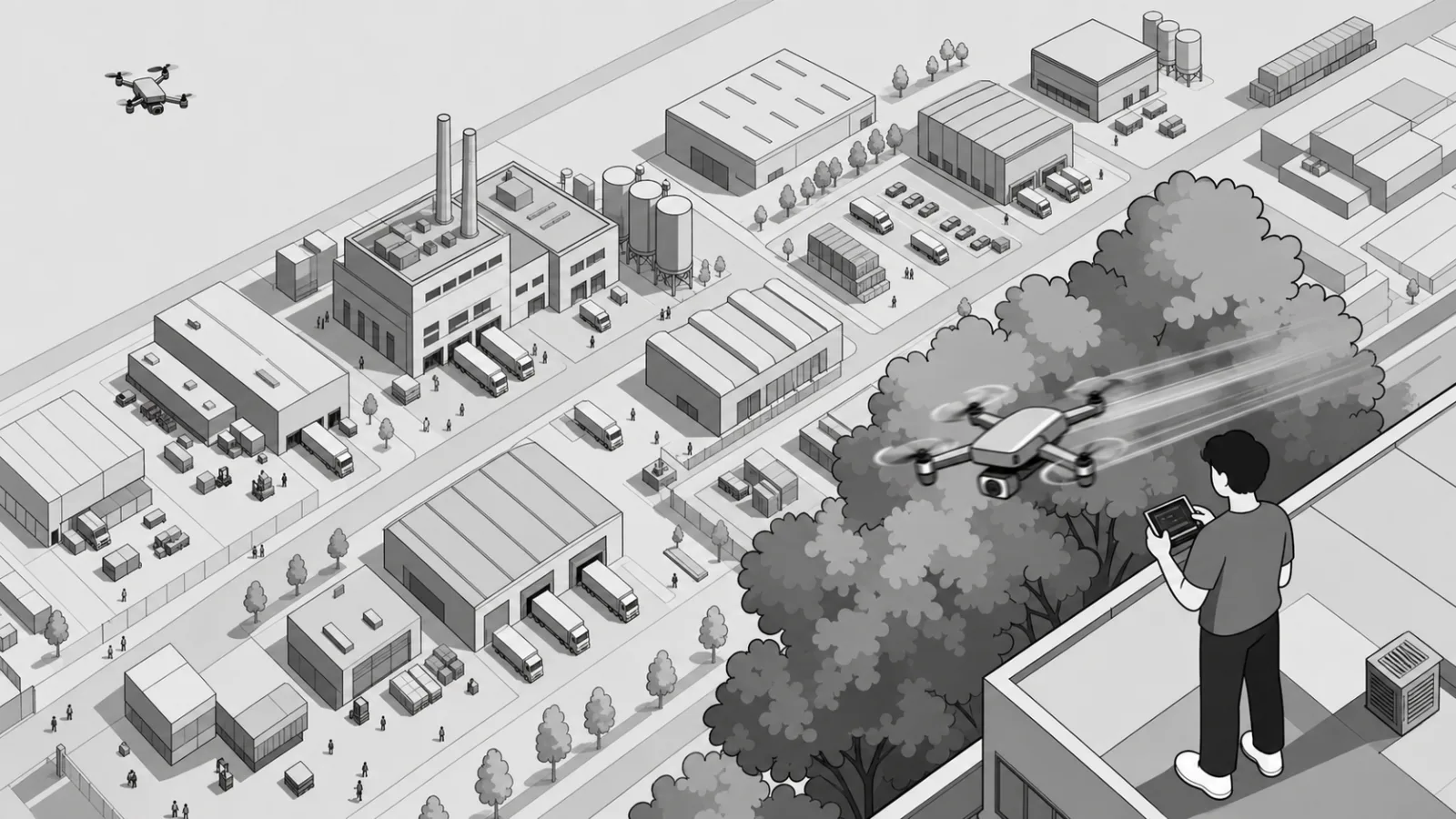
At eighty metres, nothing seems to be moving, as there is nothing nearby to serve as a point of reference. The same journey at ten metres above the ground, skimming past a tree or a roof, seems three times faster.
Flying low and fast yields better results than flying high and slow, though it requires thorough reconnaissance. That’s where the preparation time goes.
The human scale disappears beyond about fifty metres. If the film needs to identify a person or capture an activity, you descend and zoom in. An aerial shot that reduces people to mere dots documents nothing.
Speed comes from the foreground
Height slows down the apparent movement; proximity restores its dynamism.
What remains after calibration
Log, ND and cropping: the margin in post-production.
We shoot in 10-bit D-Log or HLG, using ND filters to maintain a shutter speed of 1/50. Without a filter, the movement becomes sharp and jerky, and colour grading can’t fix it.
The sky dictates the exposure. The sensor has a decent dynamic range, but we expose for the highlights: a blown-out sky cannot be recovered, whilst a blocked-up shadow can be partially salvaged.
Shooting in 6K for delivery in 4K leaves some room for cropping. This can be used to correct an imperfect flight path or to produce a vertical format without a second flight.
Most of the colour grading work focuses on matching the footage to the main camera. With a small sensor and different optics and internal processing, without a conversion LUT and manual adjustment, the aerial footage has to be matched by eye.
Technical specifications
Order of magnitude to put a project into perspective.
| Service life of an aerial when installed | 4 to 6 seconds |
| Margin to be turned before and after | 3 seconds on each side |
| Maximum height, open category | 120 m |
| Minimum distance from other road users on the A2 | 30 m, or 5 m in low-speed mode |
| The 1-for-1 rule | a horizontal distance at least equal to the flight height |
| An overview of a gathering | banned in the open category |
| Compulsory third-party liability insurance for vehicles weighing 250 g or more | At least CHF 1 million |
| Filming codec | D-Log or 10-bit HLG, ND filters required |
The legal framework, from a planning perspective
Things that need to be sorted out before the day of filming.
We fly as a registered operator, with the relevant remote pilot certificate and active remote identification. Third-party liability cover is at least CHF 1 million, which is compulsory for drones weighing 250 grams or more.
In the open category, three limits govern the flight plan: a maximum altitude of 120 metres, flight within visual line of sight at all times, and a ban on flying over gatherings of people. In sub-category A2, you must maintain a distance of 30 metres from bystanders, or 5 metres in low-speed mode, with the 1:1 rule applying as soon as you ascend.
Everything else falls under the specific category and requires authorisation from the FOCA: flying over crowds, flying above 120 metres, and flying beyond visual line of sight. Allow several weeks for the necessary procedures before filming.
First-person view (FPV) piloting remains possible in the open category with an observer who tracks the drone with the naked eye and communicates with the remote pilot. Without an observer, the flight falls under the specific category. Make sure to include this person in your budget.
Four questions before take-off
Our search filter.
1. What does this shot show that a ground-level shot would not?
2. Where does it cut, and which shot does it lead into?
3. Is the movement in the same direction as the previous shot?
4. Which element in the foreground will convey a sense of speed?
Without answers to all four questions, the shot will end up with the outtakes that we watch through once before archiving them.
A drone shot for your film
Site surveys, permits and flights are all organised together. Please describe the location and its intended use.
Sources
Regulatory and technical references.
FOCA, flight rules for drones: bazl.admin.ch/fr/regles-vol-drones
FOCA, specific category and operating authorisations: bazl.admin.ch/fr/categorie-specifique
Implementing Regulation (EU) 2019/947, applicable in Switzerland since 1 January 2023
Allianz Suisse and AXA: third-party liability insurance requirement for drones weighing 250 g or more, CHF 1 million