
Your corporate video is rubbish. Here’s why.
Beautiful imagery, inspiring music and three well-researched interviews are not enough to hold an audience’s attention. If your corporate video doesn’t tell a story, doesn’t teach anything and doesn’t build anticipation, it often serves only to reassure the people who commissioned it.
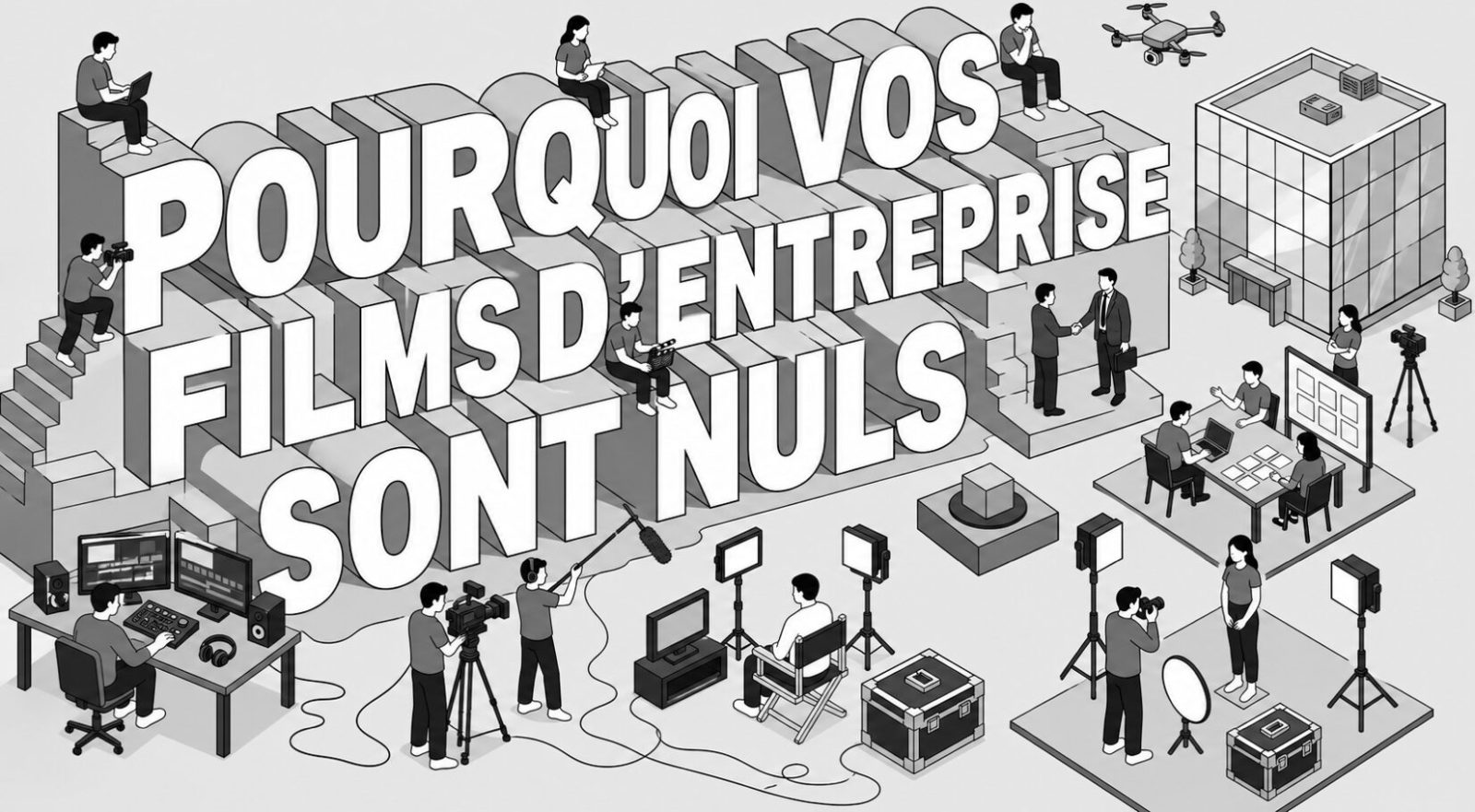
Many corporate films are technically polished, yet still a pain to watch.
A drone shot pans across the building as the music swells. The management talk about excellence, innovation and human values, then staff walk down a corridor, shake hands in front of a screen and laugh over a cup of coffee. Two minutes later, the logo appears.
Everything is crisp and perfectly colour-graded, yet instantly forgotten.
It’s not down to the camera, the lenses or the editing: this video was designed simply to showcase the company, without seeking to engage anyone’s interest.
The film that ticks all the boxes but says nothing
This type of video often stems from an internal checklist:
- show the premises;
- feature the management;
- highlight the company’s values;
- introduce all the departments;
- thank the teams;
- ending with the logo.
Each department gets its own shot, each manager approves their line, and no one’s offended, but the viewer has been given no reason to stick around.
On LinkedIn, Instagram or YouTube, no one owes you two minutes of their attention. The audience watches a video because they’re intrigued by a question, concerned by a problem, surprised by a fact, or because they can learn something from it – and your executive committee’s pride has nothing to do with it.
A video conceived as a filmed organisational chart may satisfy internal staff, but it is not necessarily content intended for the general public.
Beautiful images are no substitute for a story
An image can, of course, tell a story, and a gesture, a glance or a well-framed action can convey more than a long interview.
But a succession of decorative shots (machines running in slow motion, hands on a keyboard, a building façade filmed from a drone, staff in a meeting) does not automatically form a narrative, and without a cause-and-effect relationship, these images remain mere filler.
A story, even a very short one, requires a sequence of events:
1. a situation;
2. an obstacle or a problem;
3. a decision;
4. a result.
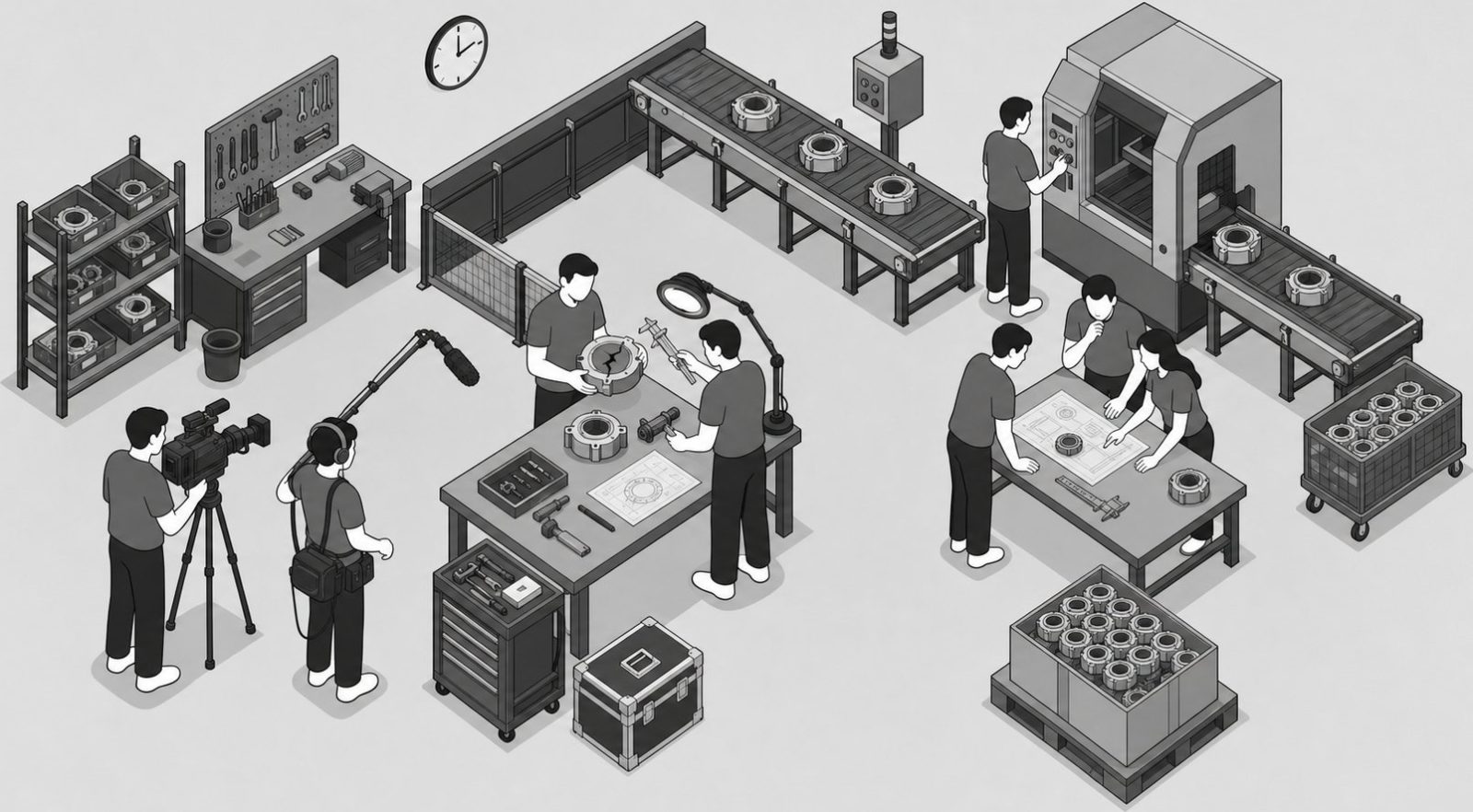
This progression can be covered in thirty seconds: a technician must resolve a problem before the doors open; a team transforms raw materials into a finished product; a local authority must organise a service despite a specific constraint; a customer arrives with a request deemed impossible and discovers how it was dealt with.
We do not need to invent drama, as real work already contains constraints, choices and consequences; we simply need to ensure these are not edited out of the film.
Two or three minutes aren’t necessarily too long
Duration is often unfairly blamed: a three-minute video may seem short if it delivers on its promise, whilst thirty seconds can seem interminable if they are filled with platitudes.
Data published by Wistia in 2026, based on over 13 million videos and 79 million hours of viewing, shows that the average engagement rate decreases with length, but also that educational content and tutorials hold viewers’ attention better than many other formats. Viewers are therefore willing to stay if the video offers them something of value.
Rather than trying to make it shorter, ask yourself at what point the viewer realises why they should keep watching.
If the answer is ‘after the director’s introduction’, you’ve probably already lost them.
Start with the audience, before the business
Google’s ABCD guide to video creation recommends starting strongly, including several peaks of interest and introducing breaks, rather than replicating the slow build-up of a traditional TV advert. This advice goes beyond YouTube advertising.
The opening seconds should build anticipation, rather than simply setting the mood whilst the logo floats over a landscape.
Compare:
Quote
« Since 1987, our family-run business has been putting its expertise at the service of its customers. »
Quote
« This part is supposed to last twenty years. We have four hours to find out why it’s breaking after two weeks. »
The first sentence is about the company, whilst the second sets the scene: it contains a subject, a risk, a deadline and a question, and makes the reader want to find out what happens next.
Before writing the script, we therefore look for four elements:
- what the audience wants to understand;
- what might surprise them;
- the person or action they can follow;
- what they will know by the end that they didn’t know at the start.
An interview is only interesting if it reveals something
An interview becomes a bore when the person on camera simply parrots what’s already on the website.
‘We put people first.’
“Quality is our priority.”
“We offer bespoke solutions.”
These statements are impossible to dispute, and therefore impossible to remember.
A good interview provides a fact, a decision, a doubt or a detail from the field:
Quote
« We halted production for six hours because a deviation of half a millimetre was enough to compromise the entire batch. »
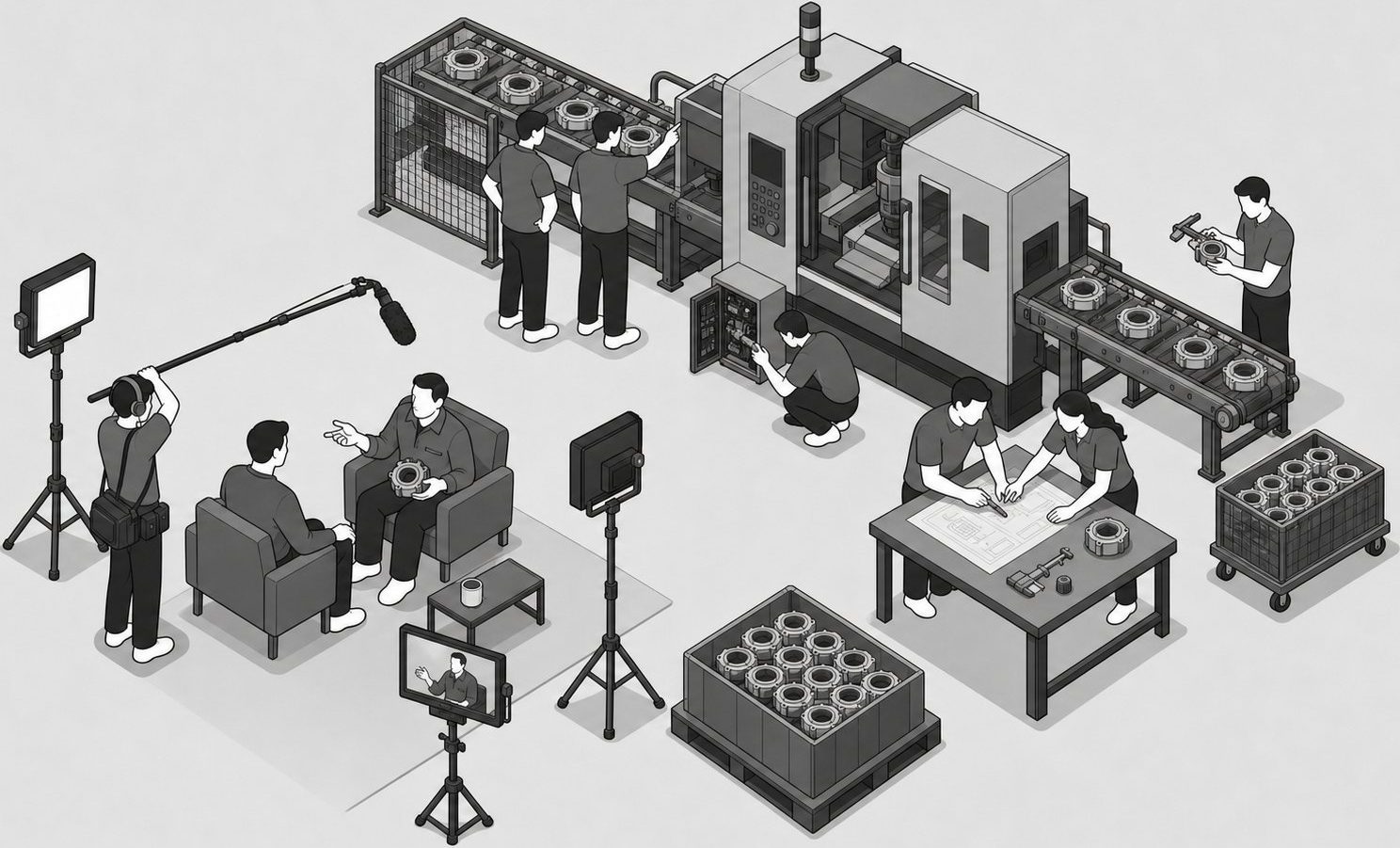
Here, we can showcase the scene, the timing, the cut, the research and the retake, so that the dialogue gives meaning to the images and the images prove it.
Filming must seek out these specific moments, which requires preparing questions, understanding the profession and accepting that a useful answer does not always resemble the script approved by the communications department.
Write the narrative before the list of points
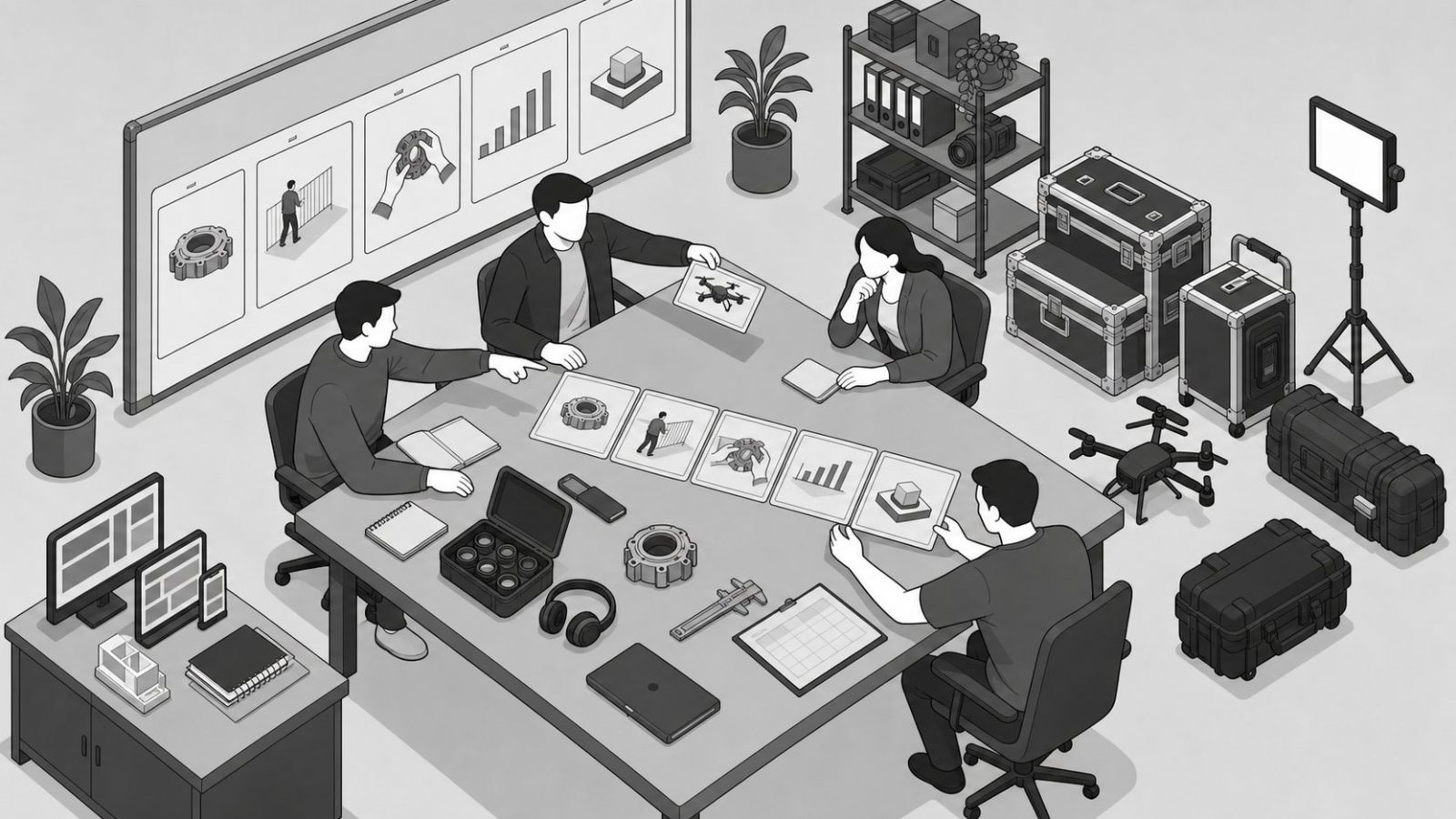
A strong corporate video can follow a simple structure:
The hook: a problem, a specific statement, an unexpected image or a visible result.
The issue: why does this situation matter, and to whom?
The journey: the decisions, actions, trials, errors and the people who drive the story forward.
The evidence: a figure, a demonstration, a transformation or an observable result.
The conclusion: what the viewer should take away or do next.
This structure makes use of beautiful shots and interviews, giving them a purpose.
The drone shot establishes a location, the slow-motion reveals a movement too quick to be understood at normal speed, the close-up creates a connection with the person we’re following, the interview explains a decision and the graphic makes a result clear. No shot is included simply because it looks nice.
An EEG study focusing on narrative videos found that narrative sequences engage attention, working memory, emotion and imagination. The sample size and context mean this is not a universal formula, but the mechanism is useful: a viewer engages more effectively when they have to understand what is happening than when they merely have to admire what is being filmed.
The simplest test
Before finalising your film, remove the logo, the company name and the statements about the company’s values.
Then ask yourself five questions:
1. Is it still clear what the video is about?
2. What makes you want to see the next shot?
3. What specific information do we learn?
4. What evidence shows that the company actually does what it claims?
5. Could another company use exactly the same video, simply by changing the logo?
If the answer to the last question is yes, the problem lies more with the perspective than with the production.
Your audience needs a reason to watch, and a two-minute mirror held up to you gives them none.
Create a video that gives people a reason to watch it right to the end
At INVprod, we start with the subject, the audience and the practical constraints before we even talk about shots: the script determines what needs to be filmed, and the camera comes next.
Are you planning a promotional film, a career profile or a video campaign? Tell us about your target audience, the distribution channel and what you want the video to achieve. We’ll get back to you with a specific angle and a concrete plan.
News
Also worth reading
Pourquoi nous ne réalisons pas de photos ni de vidéos de mariage
Weddings require time, lightweight equipment, regular practice and budgets that match expectations. This is not INVprod’s area of expertise.
Read more
Bien filmer un spectacle : les choix qui font une captation solide
Filming a performance well requires preserving the staging, anticipating the lighting, synchronising the picture and sound, and then capturing what cannot be re-enacted. The number of cameras is a secondary consideration.
Read more
Captation de spectacle : quel dispositif pour quel budget
With us, filming a performance costs between 700 and 1,400 CHF per performance. The intended use of the footage determines the price: for archival purposes, a wide shot is sufficient, whereas a film intended for broadcast requires multiple camera angles and editing.
Read more